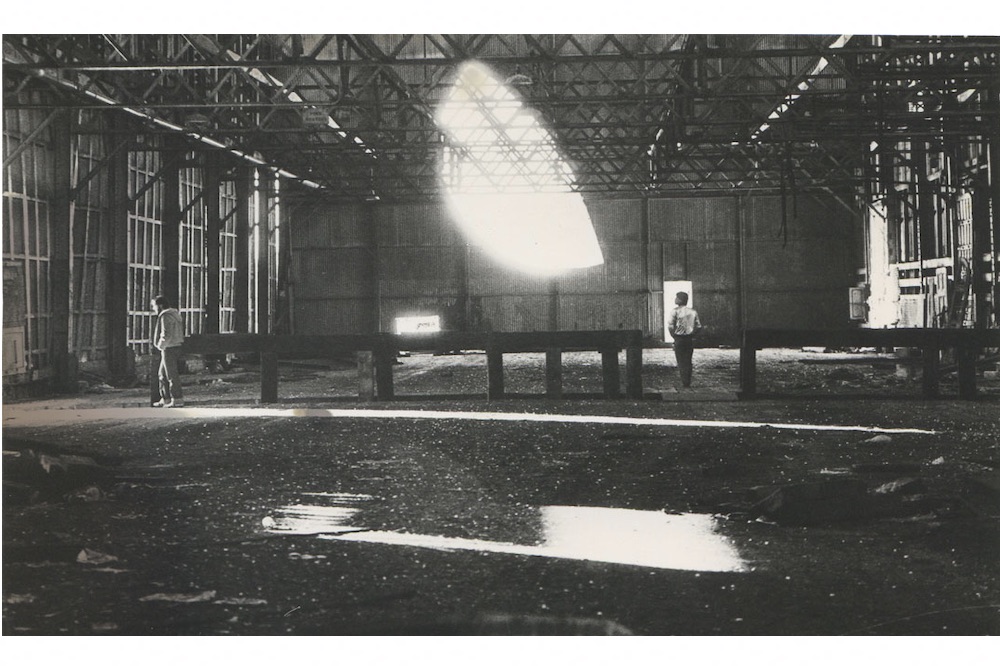
“I had no faith in any kind of permission.” So he cut off the lock and replaced it with his own, then went to work (with Gerry Hovagynian) on a disappearing fragment of the New York waterfront. Gordon Matta-Clark’s Day’s End nurtures what had been abandoned. It fulfills the promise of Giotto’s Scrovegni Chapel: to unfurl a closed architecture, cutting into the building’s circumscribed envelope to articulate it, opening it to light, unfolding a vaster space, the river below, the sky above. “An experiment in bringing light and air into spaces that never had enough of either.”
Here was the scale and ambition of Earth Art, but rooted in the city. It was sensuous, beautiful, articulate, with a breathtaking absence of compromise. “I didn’t want to be told what to do.” An unprofessional artist, seemingly unconcerned with the idea of career: such a reckless beauty.
”The only way to do it was to take possession – occupy and possess.” Here’s the freedom to create space. Here’s the scent of the ‘70s and early ‘80s, of artists making spaces, mostly illegally, demolishing walls, installing plumbing, throwing up new walls, filling the air with dust. (We wore masks then, too, but against construction and demolition.) Here’s the production of space, one with a different, intricate relation between inside and outside. Here’s the Right to the City – as Henri Lefebvre wrote, “the refusal to allow oneself to be removed from urban reality.”
I never saw Day’s End, but it must be obvious how I see it now, in this moment of isolation – as enlightenment upon seeing. The drama of light and space, the vast interior like some medieval church. The basilica, the building type that enclosed Roman public space, that became a Christian religious space, that became an industrial space. The exploration of an inherited form: working with what was given historically, inventing nothing. To slice through the history of a city with a structure of voids, to release what was already there. It had to be imagined into existence. It still exists, lodged in my mind, like a splinter.
– Andy Patton