


“During one of those sleepless nights, the thought crosses my mind that pregnancy happens to you, like dreams.”
—Jazmina Barrera, Linea Nigra: An Essay on Pregnancy and Earthquakes
Visiting AMPHI Gallery for the first time, I was led to the back entrance near a nondescript row of parking spaces, lined up in front of rear doorways in a new development in Pasadena, California. It was after dark on opening night, and the gallery was the only open business. As I entered, people spilled out from its yellow-lit doorway, an eclectic, intergenerational crowd. Immediately to the right hung Stand in (2015), Margaret Nielsen’s massive oil painting of a bear upright on his hind legs. Nearby, as if in conversation, was Nielsen’s during a dangerous game of peek-a-boo. . . (2015), depicting a teddy bear with his head turned to his shoulder. Additional troubled teddy bears by the artist hung in this antechamber, including the Enlightenment (2020) dyad, two small, ornately framed images of purple bears with their heads on fire.
At the center of the gallery’s largest space stood a curious object, a twin bed made with crisp white sheets, set in a four-poster frame on which each post was crowned with an animal: a frog, a turtle, a snake, and an alligator. Its placement suggested that the bed be read as the boat mentioned in the show’s title, A Boat Made of Dreams. This bed was where Axel Wilhite, one of the exhibition’s three artists, slept and dreamed as a child, and it was the one object in the show made by its curator, Bob Wilhite, Axel’s father. In A Boat Made of Dreams, the elder Wilhite presented his son in the company of esteemed peers, making the connection vivid, obvious: Here is the throughline, in the city of my life, from one generation to the next. From my life of art to my issue of life.
For decades, Bob Wilhite has been a vital force in, and storyteller of, LA’s art community. He made his name as a curator with the 1979 Los Angeles Institute of Contemporary Art show Sound, cocurated with the organization’s director Bob Smith, which featured performances by Llyn Foulkes (who recently died at age ninety-one), Gerald Oshita, and Yoshi Wada. Across his half-century career, the elder Wilhite collaborated with Guy de Cointet on surrealist plays with vibrant sets; designed furniture, flatware, and bars he describes as “saloons/salons”; conceived conceptual performances; and built sculptures out of wood, butterfly wings, and sound. Facts about his life and career could seem a little made-up: For instance, his flatware appeared in several episodes of Star Trek: The Next Generation, and, as a young man, he worked as a clown diver in a Japanese water circus.
The show at AMPHI spun a thread of work, pulled through the needle’s eye of the late twentieth century into the twenty-first, a vibrant and colorful series of images that told a strange story with darkness licking at its edges. The paintings and drawings felt like covers for lost speculative literature—splatterpunk, nineties poetry, the sci-fi and fantasy books that the younger Wilhite may have read himself to sleep with in the bed at the show’s center. Although each artist’s work was distinct, the pieces in this show could be collectively described as figurative, surreal, and unnerving. In its daring directness, A Boat Made of Dreams offered a kaleidoscopic journey through a Los Angeles art lineage.
In addition to works by Nielsen and Axel Wilhite, the exhibition included paintings by Scott Grieger, making the grouping as generationally diverse as the crowd at the opening. Nielsen and Grieger are in their seventies and alumni of the Chouinard Art Institute, the now-defunct predecessor to the California Institute of the Arts, where many early Disney animators were trained alongside LA art stars such as Ed Ruscha and Joe Goode. Both have exhibited extensively and are members of a generation of Los Angeles artists who turned the city into a fertile incubator for new, provocative ideas in the 1970s and 1980s. This show featured eight of Grieger’s paintings from this time—small, tight images that hearken back to that era’s appreciation for the jagged impact of vibrant color and loud feeling—and fifteen of Nielsen’s surrealist images, created between 1984—the year before Axel Wilhite was born—and 2020.
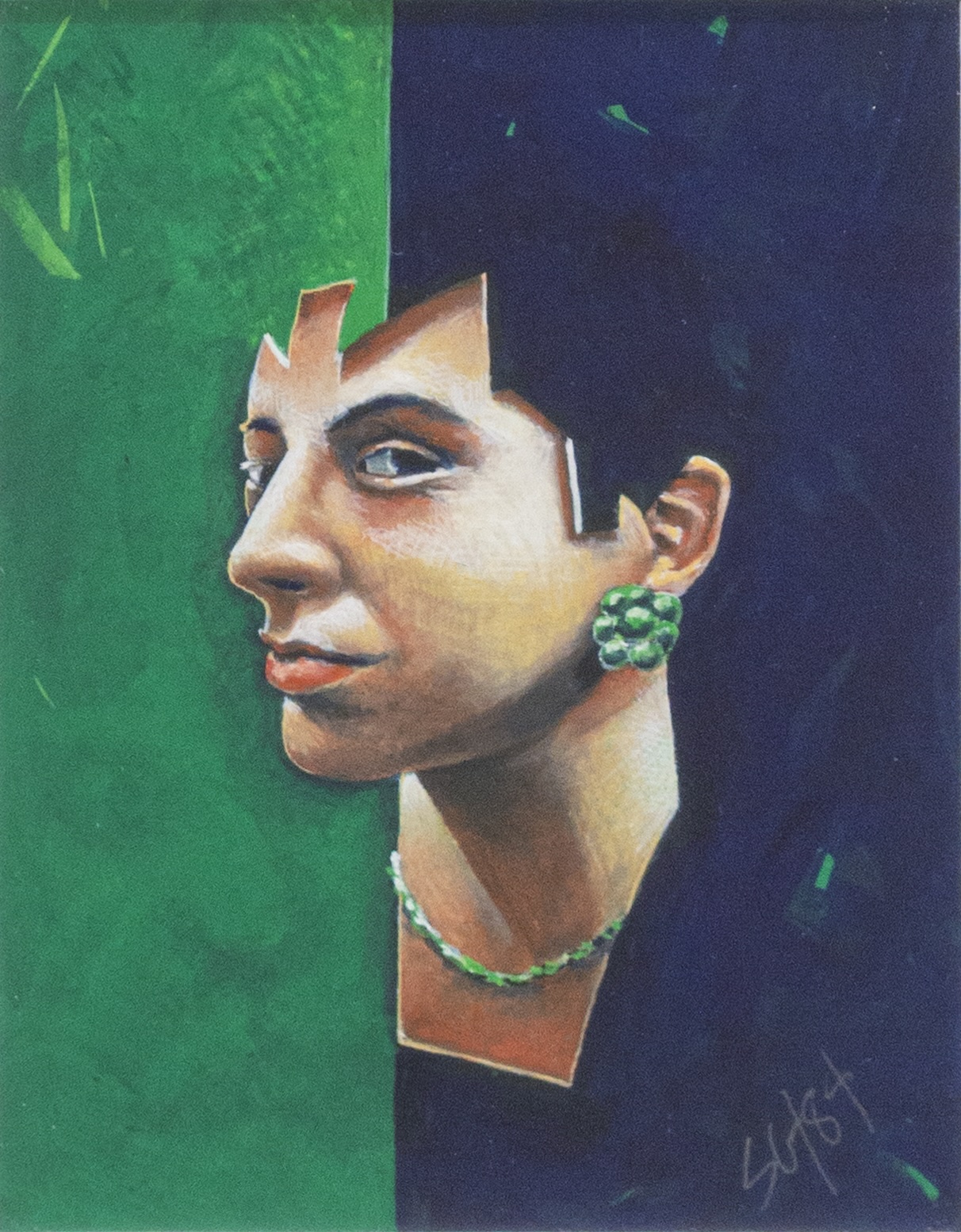
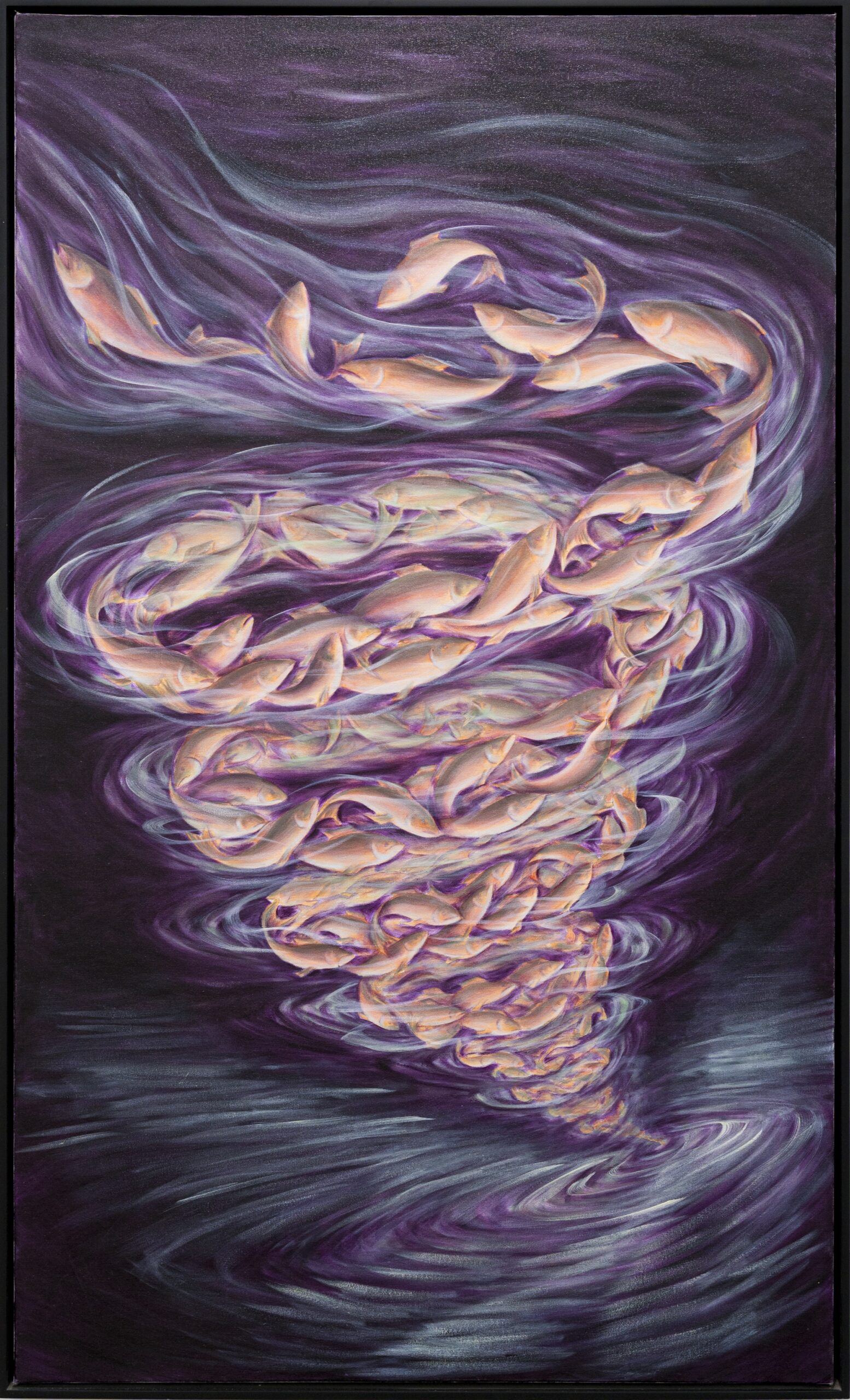
Of Grieger’s included works, LISA (1984) held the greatest feeling for me. In it, a woman’s face emerges from a bisected background, unequal parts navy and a jade green matched by her earrings and necklace. Its energy recalled the late Venice restaurant Hal’s Bar and Grill, which offered an impressive art collection, booths upholstered in a similar green, and a great burger. Grieger’s tiny faces peer out of his canvases, suggesting entire lives packed into tight confines—the figure in FRANK Stein (1985) is purse-lipped and pale-faced as Robert Blake as the Mystery Man in David Lynch’s Lost Highway; Margie S. (1985), laughing, leans over, her hair cut away in right-angle chunks, leaving only her mannequin-like disembodied head. Mischievous, maybe dangerous, maybe divine, these paintings were surrounded by white space in a room that held them like a cell. By contrast, Nielsen’s work, larger scale and more unpredictable, took the viewer out of the city and into the wild, with a compelling and archly American sense of the unknown animating her large and small canvases. Paintings such as Regeneration (2006)—a disconcerting tornado of luminous fish—suggest an irresistible grandeur that beckons and frightens all at once.
Together, the works of Nielsen and Grieger framed the presentation of Wilhite’s spells, portents, and gloomy wandering concerns—as if midwifing forth the younger artist’s work, leading the viewer to the next chapter of these channelings. The grouping of drawings by Wilhite infused the commonplace practice of recording dreams with the solemnity and rigor of ritual magic. Wilhite was the co-gallerist of the former Space Ten Gallery in Hawthorne, where undersung LA artists Laurie Pincus and Madam X received expansive retrospectives. He shares his father’s interest in tracing connections between and platforming other artists. His work has a restless, ruminative quality, as if animated by anxiety and curiosity alike; exemplifying this are fine graphite drawings of unlikely scenarios such as crocodiles swarming an Airbnb kitchen and an evening of revelry in a war camp.
While Grieger’s and Nielsen’s paintings range in size from as small as a postcard to as large as Nielsen’s ten-foot-tall bear, Wilhite’s works are all around the same size, a little larger than an LP. All depict otherworldly and unnerving scenes, described in the artist’s laconic voice in paragraphs that appeared below the images. The first words of each caption double as each piece’s title. In My father has been kidnapped and held for ransom . . . (2020), a recognizable Wilhite père is enchanted into a bottle by cavorting goblins. In Ayahuasca: The first night, nothing. The second night, I am ushered into some kind of procession, a parade . . . (2021), a motley, somewhat Boschian crowd approaches an egg-shaped dwelling guarded by a massive snake. If Nielsen’s and Grieger’s works offer glimpses at—and visitors from—the unknown, potentially malevolent world motivating and inspiring the exhibition, Wilhite’s images offer something more like a lifestream from within this realm: a place, Bob Wilhite seems to suggest with his curation, from which a deep well of meaningful inspiration may course through Los Angeles artists. The show revered and celebrated mystery, recommending it be handled with care.
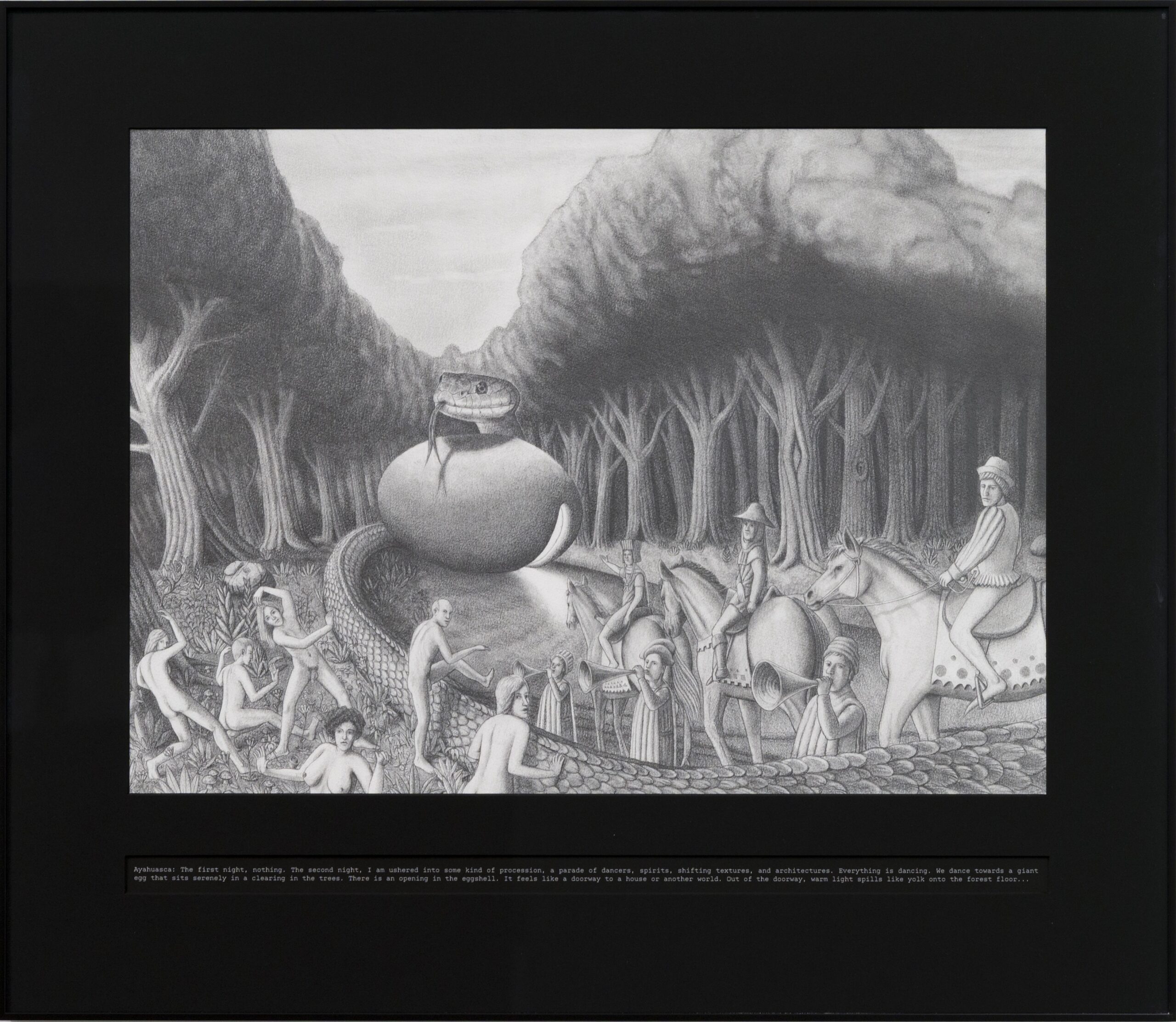
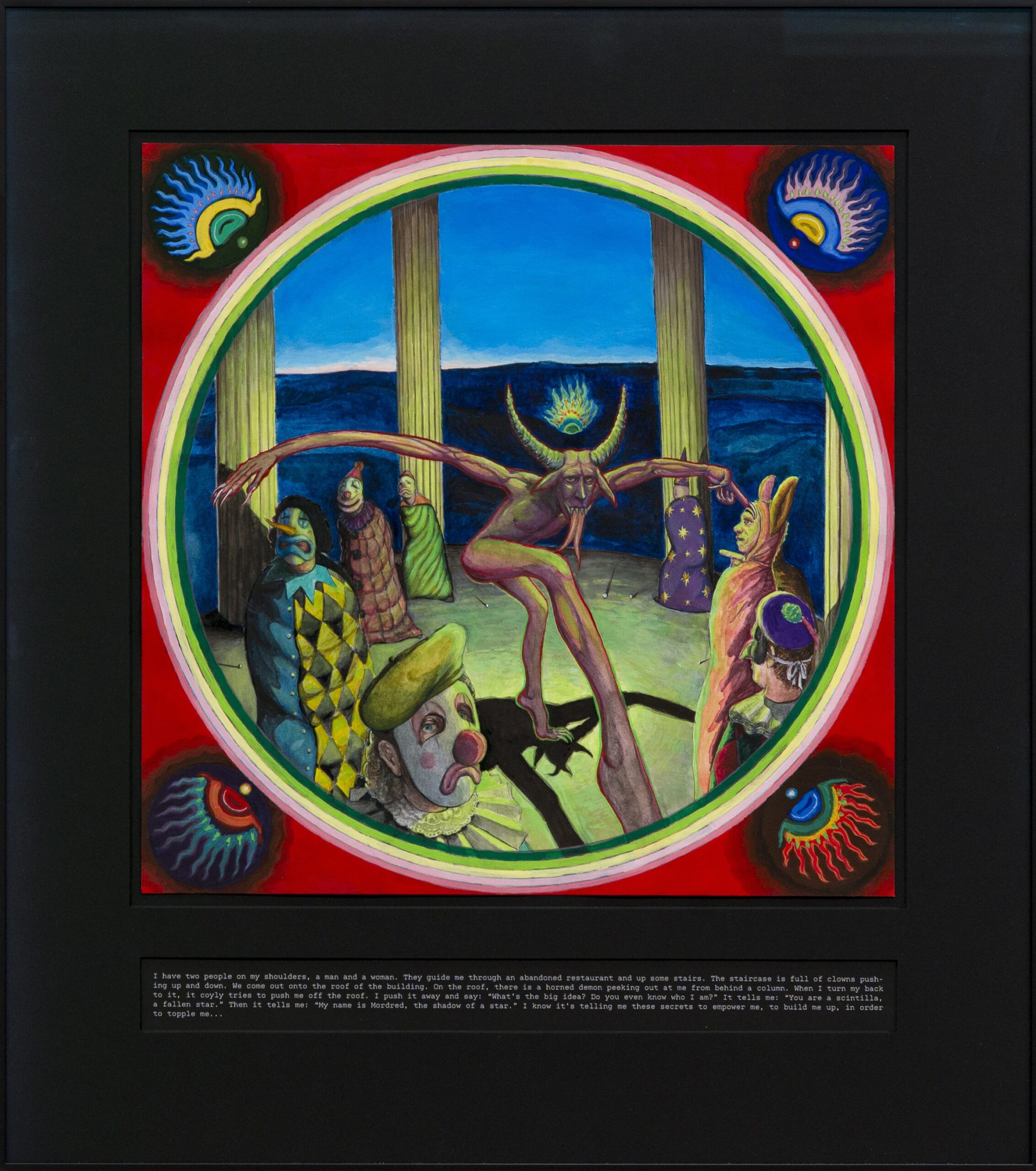
Axel Wilhite’s drawings brought to mind particularly odd yet somehow domestically familiar children’s book illustrations, along with a host of other influences. Most evident, and surprising, to me were the connections between the younger Wilhite’s work—presented as straightforward depictions of his dreams and visions—and the work of midcentury artists and LA underground forebears such as Marjorie Cameron, whose Peyote Vision (1955) so upset the Los Angeles Police Department that it shut Ferus Gallery on a charge of lewdness for including the drawing in a 1957 exhibition. With its lurid framing and color, an acrylic by Wilhite titled It says it’s telling me these secret truths to empower me, to build me up higher, so that it hurts more when it topples me . . . (2022), struck me as ideal for inclusion in a Crowleyian grimoire. In the painting, a demon lopes in the center of a circle of clowns and a crouching wizard with his back turned to us. The figures peer over their shoulders at the viewer, beckoning, challenging. But where Cameron had the benefit—and/or demerit—of the notoriously male-dominated Ordo Templi Orientis chapter in Los Angeles, Wilhite works alone. As he writes in his summary below the painting: “It tells me, ‘you are a scintilla, a fallen star.’ Then it tells me: ‘My name is Mordred, the shadow of a star.’” Perhaps these images and stories reflect a unique subject position, sharing with the viewer what it is like to be born and raised within the universe of unconscious images and forces that this exhibition summons with its spell.
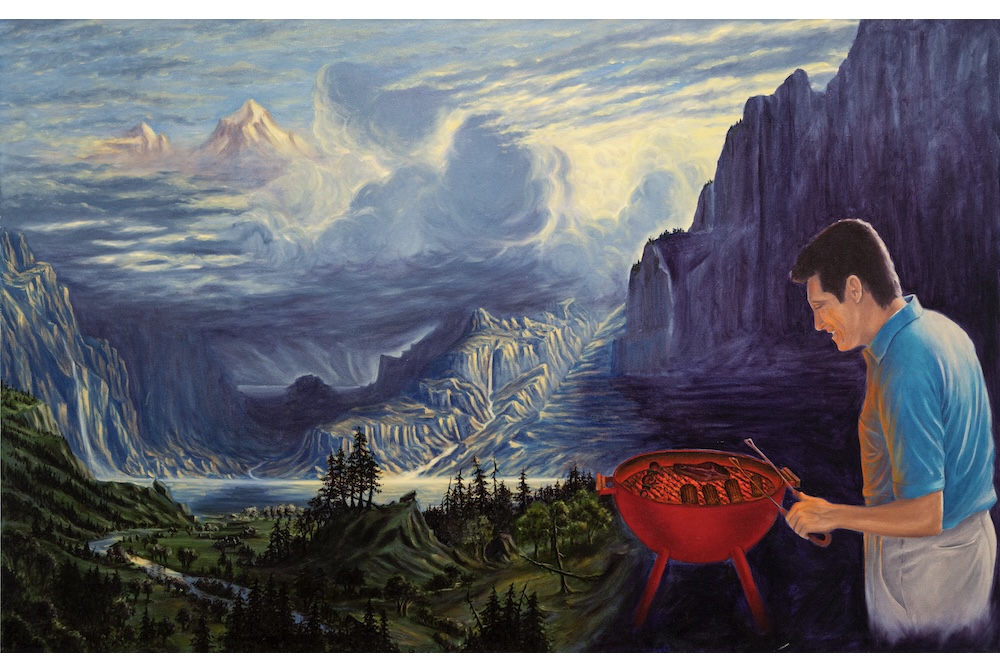
In Bob Wilhite’s deft, playful hands, A Boat Made of Dreams spun a thread of works that sometimes seamlessly connected. Nielsen’s majestic Storm in the Rocky Mountains-Mt. Rosalie (1990) beamed ominously out at the bed and the wall of dreams beside it. Grieger’s tortured little faces loomed out of their faraway chamber. The feeling was of passage, a river of thought and image, pregnant with the potential of other worlds. The viewer rode after history, lambent, shedding light, seeing something up ahead. A light shone back, showing me myself.





































































































Contribute your thoughts by leaving a reply