


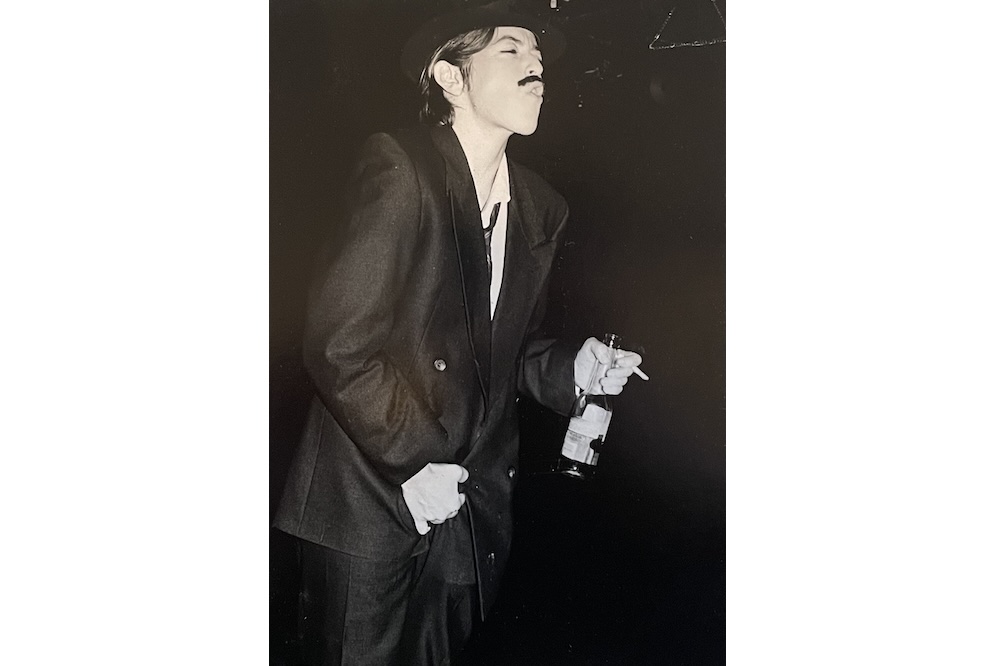
Pat Oleszko may be funny, but she isn’t joking. For nearly sixty years, Oleszko—a performance artist and sculptor who describes herself as an artist “who makes work that lives, breathes, walks, farts, and fucks”—has crafted costumes, nylon inflatables, and performance works that satirize the world’s injustices with caustic, colorful wit. Born in 1947 in the suburbs of Detroit, Oleszko enmeshed herself in the experimental, political scene of University of Michigan’s sculpture department in the mid-1960s, and discovered her brash, comedic performance style working in Toledo, Ohio burlesque clubs as “Pat the Hippie Strippy” before moving to New York at the end of the decade. While her contemporaries in performance addressed topics such as American imperialism, the AIDS crisis, and women’s rights with grave seriousness, Oleszko—armed with absurd costumes and a clown’s sensibilities—chose a different tack, creating performances that invited audiences to acknowledge the cruelties of the word while, crucially, laughing at the people, systems, and norms causing this strife. Fool Disclosure, Oleszko’s current retrospective at New York’s SculptureCenter and her first institutional New York solo exhibition since 1990, finally takes this underappreciated artist’s humor seriously by considering the intelligence and anger that fuels her satirical vision.
Tasked with organizing Oleszko’s decades-long body of work, Fool Disclosure’s curators—Sohrab Mohebbi and Jovanna Venegas with Sharon Liu—separate the artist’s pieces by medium: inflatables on the first floor; costumes and archival material in the basement-level gallery. In organizing by medium rather than content, the curators both acknowledge and subvert Oleszko’s exhibition history, which, until her 2024 comeback gallery show at David Peter Francis, had largely involved categorizing her work as craft and design, not properly recognizing that her costumes and props were meant to be seen as part of a performance. It feels corrective, then, to open the show with Oleszko’s inflatables, her most ambitious works and objects that she not only uses in performances but that are animated, performative in themselves. Rippling and swaying as a result of the blowers, these sculptures, and their effective arrangement, make entering SculptureCenter feel like walking into an Oleszko performance. Situated directly on the concrete floor and without any of the obvious barricades, these sculptures beg a closer look; luckily the audience can get so close as to smell the old nylon fabric. Octopussy (from The Rat That Stole the Tiber) (2003)—a lime green octopus with dangling tentacles, installed on the beams overhead—looms over the exhibition like a B-movie monster, and Three Bozos (1985)—a set piece used in her 1989 performance Bluebeard’s Hassle: The Writhes of the Wives—swings from the ceiling, its three interlocked figures rotund and colorful with their excess of flailing limbs.

One of Oleszko’s most outré inflatables on this gallery floor represents her life-long—and imperfect—engagement with feminism. Originally used for her 1993 reinterpretation of the book of Genesis called Nora’s Ark: Pa’t Too, Womb with a View (1990), features a headless, armless woman lying on her back with her legs splayed in front of the viewer. In this compromised position, the figure’s comically large breasts and fire-engine red nipples are pointed to the sky, and the focal point is the mons pubis, with low-pile black carpet for pubic hair and a zipper—which visitors can unzip and stick their head in—for the vagina. There are a range of meanings within this single piece: a clear, if somewhat essentialist, statement on women’s liberation and reproductive justice, or a parody of the constant presence of the fertile mother archetype in art, from Courbet’s L’Origine du Monde to Niki de Saint Phalle’s She–A Cathedral. Taken all together, Womb with a View is a deliciously crude affront to good taste, provoking its audiences to be both appalled at its crass approximation of the female figure and the widespread dismantling of bodily autonomy.
Other inflatables in Fool Disclosure continue the artist’s feminist explorations but have a different target: the men in charge. Her performance Roamin’ Holiday: A View from a Broad (1999) was a repudiation of the Catholic Church’s ancient misogyny. Developed in residence at the American Academy at Rome and briefly presented guerilla-style in the Vatican City, leading to her arrest by Vatican guards, the performance skewered the pomp and circumstance of the Catholic patriarchy by portraying the Pope as a small, shrill figure worthy of mockery. It is immortalized here by the inflatables Swish Guard; Duh Nincompope, a cartoonishly phallic rendering of a pope hat; and Temple of Been Here (all 1999), a classic Roman temple with the work’s title spelled out on its pediment to drive home the form’s datedness. Together, these works gleefully follow the fragility of the male ego to its natural and pathetic conclusion: dick jokes.


Turning to the failures of another patriarchal institution, Oleszko’s work from the early 2000s focus on the failure of American government during the War on Terror. A grouping of four works from her 2007 performance against the war on Iraq, The Deportment of Corrections at the Museum of Contemporary Art Detroit, stand at the center of the gallery. The imposing General Dismay looms tall in a navy-blue uniform and police hat. On his torso, words including “disapproval” and “nuisance” are spelled out with overlapping Scrabble tiles. Next to General Dismay are two piles of inflatable missiles (3 Miss Ills and Miss Ill Cluster), each featuring a riff on the word “missile”: “miss-take,” “miss-deed,” “miss-hap,” and many others—a potent mix of visual punning and wordplay. She conceived these works in response to then-President George W. Bush’s use of false weapons of mass destruction allegations to justify the US invasion of Iraq, an act so miss-guided it borders on hilarity, cruel and ridiculous. The final figure in this configuration, WarUSaurUS, is a cartoonish dinosaur eating a human figure made from the American flag, except the flag’s stars have been replaced with small white crosses.
While the main gallery does justice to the artist’s nylon sculptures, the subterranean galleries offer insight into Oleszko’s development as an artistic and comedic talent. The organization of this archive of her costumes, films, and ephemera feels somewhat traditional in comparison to the first gallery, but the largely biographical insights it imparts amplify the power of her work. The artist’s Iraq War pieces, such as General Dismay and WarUSaurUS, take on a new poignancy alongside a selection of simple pre-9/11 photographs of the Twin Towers silhouetted against a blue sky, installed in the same vitrine that includes an unofficial, worn-out ID badge that she made to identify herself as she helped with clean-up at Ground Zero, mere blocks from her long-time Tribeca apartment.
The earliest costumes in the exhibition are taken from the 1971 series Act Three: The New Yuck Women. A minor and misguided work, the series is too reliant on stereotypes of sexual agency and class that Oleszko would later approach with more nuance. Yet, there are fragments here of what would become Oleszko’s signature humor and craftsmanship, particularly works such as Fishwoman and Women’s Libber that feature comedic fabric accoutrements and exaggerated body parts. Indeed, The Handmaiden (Japan) (1975) features a vortex of extra limbs that the artist untangled during a striptease performance as a chant of “get your hands off of her!” continued, speeding up, in the background––reclaiming bodily agency while celebrating the salacious wit of burlesque.

A small screening room shows these costumes and inflatables “in action,” featuring documentation of Oleszko’s public performances across the US and Europe. At a 2007 performance-cum-protest, the artist, giggling and decked out in papal robes, sits inside A Womb with A View, waiting to deliver a “blessing” to passers-by brave enough to stick their heads through the sculpture’s “vagina.” Seeing the way her unknowing audience is drawn to the work, even if they remain uncomfortable, reveals her humor and outrageousness as an irresistible Trojan Horse for her political messaging.
The most recent work in Fool Disclosure is The Fall of Democracy (2025/2026), an ensemble consisting of a hat shaped like a classical column—a literal pillar of democracy—and matching gloves. Fragments of paper printed on a mock version of the Bill of Rights (as well as caution tape) wrap around the hat, and in the palms of the gloves are two leaf-shaped paper cutouts with the names of Renee Good and Alex Pretti, the two Minneapolis residents murdered by ICE the week before the show’s opening. It is incredibly sobering, and Oleszko makes no attempt to cut these raw feelings with jokes, a uncharacteristic move that signal how uncharted this moment in American civil life truly is.
In 2024, Pat Oleszko was interviewed about the role of humor in her work. She responds, perfectly describing her modus operandi: “I think that humor is incredibly powerful, and I take it very seriously.” In an age where state and imperialist violence is tragic to the point of absurdity, it is inspiring to see the oeuvre of an artist whose glee stands in opposition to terrors of patriarchal war machines. SculptureCenter’s Fool Disclosure excels as both a tribute to an exceptional artist and a blueprint for how to navigate horror without losing hold of your own humanity. Consider it a tour de farce.


































































































Contribute your thoughts by leaving a reply