


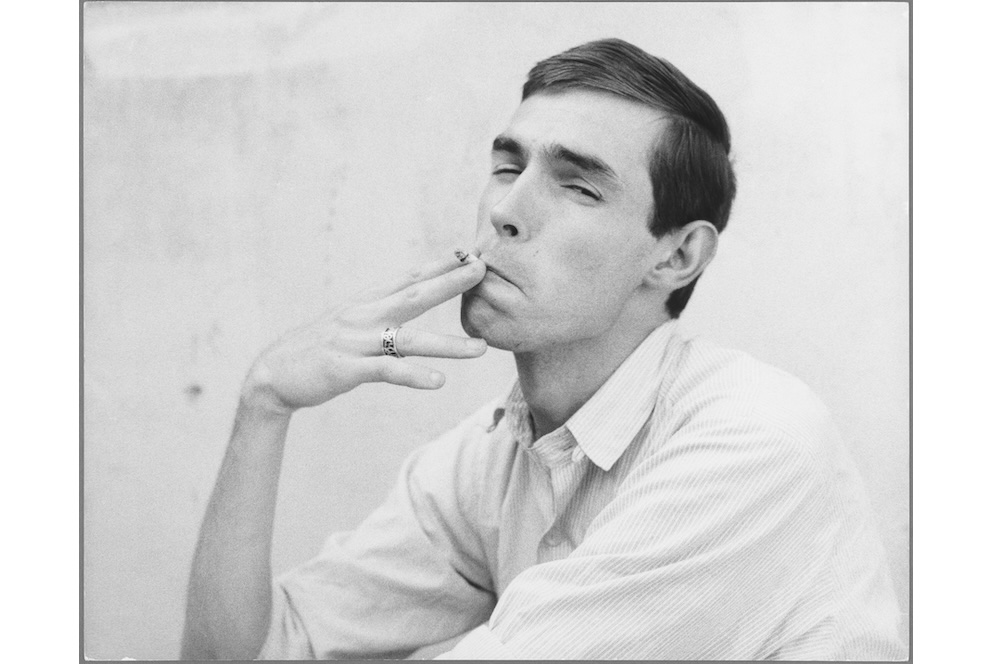
The year is 1974, and a pack of cigarettes costs 56 cents in New York. Photographer Peter Hujar spends 89 cents on an Oscar Mayer liverwurst. “It’s expensive. But I was hungry, and I splurged,” he recounts to the writer Linda Rosenkrantz for her book on a day in the lives of people ranging from her 14-year-old cousin to the artist Chuck Close. At Rosenkrantz’s East 94th Street apartment on December 19, Hujar describes at length the activities from the day prior.
Though Rosenkrantz’s book has gone unrealized, Ira Sachs’s 2025 film, Peter Hujar’s Day, follows the transcript of her exchange with Hujar. There are no flashbacks, testimonials, or narration, just two people having a conversation in different rooms of an apartment and on a rooftop. Neither expository like a documentary nor experimental like a single continuous-shot film, it is, most simply put, a multi-angled reenactment that offers a look into the life of a man who is remembered as a key photographer of his generation. As the two talk, they make coffee, eat cookies, light candles, and smoke cigarettes. The loud noise of nearby construction rings in from an open window, and we see the sun slowly set. It’s these elements that keep the atmosphere lively.
At its core, the film stages a conversation between an artist and a writer who have been friends for nearly two decades—a dynamic I can’t help but compare to my own relationships with artist friends. Our exchanges rarely descend into the kind of minute detail demanded of Hujar, nor do they remain so narrowly fixed on a single thread. This is where Peter Hujar’s Day falters: It leaves little room for humor or provocation. Those immersed in New York’s contemporary art world—where even casual group chats can feel sharper and more revealing than what’s presented here—may find the film’s banter, as delivered by Ben Whishaw and Rebecca Hall, unexpectedly flat.

For a fuller sense of Hujar’s relational world, one might turn to Primary Information’s publication Stay Away From Nothing: Paul Thek and Peter Hujar, which collects Hujar’s letters from artist Paul Thek, or Andrew Durbin’s forthcoming biography, The Wonderful World That Almost Was: A Life of Peter Hujar and Paul Thek. Hujar met both Rosenkrantz and Thek in 1956, and these texts expand on what the film only sketches. Read alongside them, Peter Hujar’s Day becomes less a simple record of an afternoon and more a fragment of a longer, more complicated portrait of friendship—one that proved to be lifelong and, in the background, one that faltered. Together, these works illuminate the messiness and emotional complexity of interpersonal relationships, offering a more vulnerable and nuanced view of Hujar’s inner life and the creative circle he inhabited.
It’s these connections—sometimes fleeting, sometimes enduring—that sustain us in an art world often mistakenly defined by a wealth and glamour that ignore the mundane and unpleasant experiences that fill an artist’s day. In the film, Hujar recapitulates sleeping through his alarm, the arrival of an Elle magazine editor to retrieve his photos of model Lauren Hutton, a phone call from writer Susan Sontag, napping, photographing Beat poet Allen Ginsberg for The New York Times, napping again, and dinner with critic Vince Aletti. It’s an impressive itinerary, but Hujar’s description of the day is interspersed with drawn-out details about quotidian worries, which bring his legendary career in the making back down to earth. Forty at the time, Hujar was little-known, though his portrait of actor Candy Darling on her deathbed had appeared in the New York Post earlier that year. (Rosenkrantz, also forty, had published her controversial Talk book to divisive reviews six years prior, in 1968.) I’m reminded of moments in which artist friends have confided in me about their own fears of career stagnation, except they are only in their 30s.
The fraught financial realities experienced by Hujar and his peers are sobering in the way they resemble the lives of artists and writers today. Hujar doesn’t know how much Elle will pay him for his photos, and he tells Rosenkrantz that there were times when he wouldn’t dare to ask; he would simply hope to receive a check in the mail. Hujar says in the film that one of his photographs of playwright Robert Wilson was reproduced in the June/July 1974 issue of Vogue Italia without permission or payment. The writer of the profile and first editor of Interview magazine, Glenn O’Brien, apparently wasn’t paid at the time either. Hujar’s unpaid or yet-to-be-paid invoices total to $825, or approximately $5,400 today when adjusted for inflation.

Much of Hujar’s recounting of his day is peppered with prices, highlighting the way that costs of living dominate even the most minor action. In a 2025 interview, Rosenkrantz remembers, “He never had any money. Everybody knew—if you wanted to have dinner with Peter, you had to pay […] And toward the end of his life, I was running around trying to sell prints of his for, like, $200—to my friends. And I did sell some. But he had no money. None.” Artists too often make a living from their work only after their death. A conceptual artist exhibiting in biennials internationally recently told me that she can barely afford groceries and is three months behind on rent. Talent does not necessitate career success, and even when it does, financial stability rarely follows.
Besides these unsavory aspects of artistic life, the exchange between Hujar and Rosenkrantz reveals distinct personality quirks. Hujar doesn’t like the “awful chalky feeling” of eating a persimmon. He doesn’t own a watering can and instead waters his plants with a coffee pot that he fills in the bathtub because the pressure is better. Portions of their conversation parallel ones that I’ve had with friends, such as the importance of a couch, especially when bringing a lover home. Hujar expresses feeling bloated, and Rosenkrantz hypothesizes that his stomach has shrunk from not eating enough. A fiber artist sends me her before-and-after photos to convince me of the efficacy of her anti-bloating vitamins; a different fiber artist claims that she once developed abs from shivering in the winter cold; a sculptor half-jokes about going on Ozempic; one of the fiber artists shares a photo of her meal: a can of beer and a cigarette. Rosenkrantz is upset by how much Hujar smokes, but it’s hard not to choose cigarettes when a pack of them costs less than an Oscar Mayer liverwurst and you’re owed hundreds in unpaid invoices.
Even the way Rosenkrantz and Hujar gossip feels familiar—they’re crude and honest. While discussing the Beat writer William Burroughs, Rosenkrantz says, “I like his face,” to which Hujar concedes, “It’s not repellent.” Once, while I was lounging in a painter’s studio, I confided in her about a recent failed relationship, and she burst into laughter when she saw a photo of the source of my woes. When a different artist sent a picture of an ex-lover to our group chat, I succinctly responded, “Ugly.” There’s a level of sustained trust and understanding needed among friends to be able to joke candidly in a socially unacceptable manner, as epitomized by Rosenkrantz’s proclamation to Hujar: “Ginsberg will just be a fat old Jewish man. He’s always been very ugly.”

But the film only hints at the messy interpersonal friction that is fully, engrossingly portrayed in Stay Away From Nothing and The Wonderful World That Almost Was. Both books focus on the relationship between Hujar and Thek, who died from AIDS-related illness at fifty-four, less than a year after Hujar died at fifty-three. While The Wonderful World That Almost Was acts as an overlapping two-person biography, Stay Away From Nothing juxtaposes Hujar’s photographs of Thek with Thek’s letters to Hujar. The two met through mutual friends in the winter of 1965, when they were both in their early twenties. Over time, the friends became lovers, then friends again, and, eventually, something too complicated to reduce to a single word.
In Rosenkrantz’s book Talk, the character of Clem Nye is a composite of Hujar and Thek, a reflection of how close the two were in the summer of 1965. Nearly a decade later, when Hujar describes his day to Rosenkrantz, he doesn’t regard Thek as an interlocutor in the way he does Fran Lebowitz and Susan Sontag. There is a brief mention of a Paul with a house in Rome, a rare instance in the conversation where a surname is not attributed, but we can infer that Hujar and Rosenkrantz are referring to Thek, who spent most of the fall and early winter of 1974 and 1975 in Rome and Ponza. “This was no great master,” Hujar says to Rosenkrantz, referring to Paul. Their friendship had been deteriorating for some years due to disagreements, misunderstandings, and Thek’s mental health.
Much later in their conversation, Hujar shares with Rosenkrantz his desire to publish a photobook, ideally with an introduction written by Sontag. The following summer, in August 1975, Hujar contacts Thek to sit for what would become Portraits in Life and Death (1976). According to Durbin, “It mattered to [Hujar] that Paul should appear in the book; it would not be complete without him.” Thek reluctantly agrees to be photographed—writing in his notebook, “Who in his right mind WANTS his picture taken??”—but it would take two sessions to produce the images that would come to be printed.

After the second and final session, Thek drafts an accusatory letter to Hujar, asking for his portrait to be excluded from the book unless it was “absolutely necessary,” and, if it was, he should ask himself why. However, the letter he ultimately sends is much more cordial, and he asks Hujar for proof sheets or a copy of the photobook. He concludes the correspondence with, “Any time you want to make love, just ask me.” It was his last known letter to Hujar.
In one of Hujar’s final photos of Thek, he stares out just past the camera lens, his mouth slightly open, head tilted. With a stubbly beard and wrinkles lining his forehead, Thek has visibly aged compared with how he looked in Hujar’s New York studio in 1960, when, boyish and shirtless, he playfully swung his shirt around for the camera. “You and I were known to each other before,” Thek wrote in his notebook around 1975. “We have passed each other, or perhaps we have not, or perhaps we have passed often, but we come from long distances now to find each other.” Hujar extended a hand by asking Thek to sit for a photo (twice), and Thek begrudgingly agreed (twice). Ruptures between friends can be repaired only if both parties are willing. “My distance is a tiny jump,” Thek continued. “I do not know your distance, but I can feel it. A small step. We can feel our journeys end.” When the two reconvened, the sense of trust, not to mention affection, that the camera once mediated could no longer be found.
When Hujar was diagnosed with AIDS at the beginning of 1987, he called Rosenkrantz, and they sobbed over the phone together as he repeated, “I don’t want to die. I’m too young.” Thek heard the news from a mutual friend; the two had hardly spoken that decade. When he called to reconcile, Hujar wouldn’t speak to him.
While writing this, I read excerpts from Durbin’s book to a friend to summarize the sobering dissolution of Hujar and Thek’s friendship, which was marked by moments of mutual stubbornness and contempt. He tells me, “I know so many gays in Bushwick who are just like him.” I ask, “Paul or Peter?” He pauses for a second to consider his answer before concluding, “Both of them.” New York looks different now than it did in 1974—when Hujar lived in the East Village and felt apprehensive venturing to the Lower East Side to photograph Ginsberg—but the capitalist mechanisms of the art world and the friendship dynamics forged within it remain largely unchanged. Like Thek, I have old friendships that I would like to repair; and like Hujar, there are ones that I would not resuscitate. And then there are friends I hope will stay, as Rosenkrantz did for Hujar, to the end.































































































Contribute your thoughts by leaving a reply