
I’ve spent the better part of five months trying to write a review of a show that’s now closed: MOCA Toronto’s inaugural exhibition, Believe. A month ago you might have rightly asked, “Surely this thing isn’t coming together. Perhaps you should hang it up?” I barked that very sentiment into some nearby snow, this morning, before polishing my bowls. But as time marched on, an eerie quiet was gathering force. Nobody else was saying anything about this show. Only the Star has published a review, and in its early, seemingly unchecked exuberance, it said nothing that the curators couldn’t shout. So, silence still. And in matters of Canadian art, a collective muting signals a familiar but urgent sign: that we’re overdue to make some noise.
The question has turned, then, from “should this be written?” to “how?” Along the way I’ve asked myself, “how do you approach a bad show by a museum you want to see thrive?” And, “how do you unbraid a curatorial misstep from the intentions of its institution?” Then, “How do you signal your support for the good artists involved in a thoughtless presentation?” I’ll cut to an early answer: MOCA Toronto’s first-show problems can be filed under poor curating, or curating-as-museum-marketing. But there are several factors that make this true.
First, let’s remember the context and trajectory of this new MOCA. It grew out of MOCCA, the Museum of Contemporary Canadian Art, which, however provincially framed, was a rare museum for its accessibility and apparent disregard (or at least hesitant adoption) of artworld trends and borders. Since its mythic start in Toronto’s suburb of North York in 2001, it moved to downtown’s Queen St. West, helping establish its cultural cool. Under the founding stewardship of David Liss, MOCCA became known for its punk, upstart, self-determined romance, and its willingness to put a name to local aesthetics. In its thirteen years at that location, MOCCA was synonymous with provocation, feeling, grit, hustle, and community. Its openings played to a theory-averse, nose-thumbing crowd, and heralded a bruising regard for art’s potential and limits. MOCCA helped identify – however superficially – at least two generations of Toronto art, and, at its height (and always at its base), played host to the scene’s most lurid parties. You heard stories of what went on in the offices of the Power Plant, sure, but nothing matched MOCCA’s ability to splash out and bare all. We saw ourselves revealed through overheated rivalries, pent-up wants, stalled-out identity crises, and unchecked desires, laid down, damp and panting on the pavement. In a single evening at MOCCA, you could witness important relational shifts, new art, and scraps over how we should scribe Toronto’s forever-unwritten art history.
In 2010, Liss smartly partnered with the National Gallery of Canada (an important collecting institution that, in Ottawa, is all but siloed). Liss showed us how to transcend institutional hierarchies and insist on collaboration. And, for a time, he raised the tide for his own ship while bringing attention to an overlooked collection. But MOCCA’s limitations became pronounced when the NGC’s curatorial program started to overshadow theirs – against the strength of the National Gallery, Liss’s instinctive but unstudied approach became a bit glaring. It was time to scale up. At parties, Liss would start to murmur his ambitions for becoming a “MOCA” museum. I noticed that. I also noticed that, soon after, he set about it.
Between 2015 and 2018, MOCCA went dormant. It spent three years rebranding, moving, reconstructing, and growing its staff to accentuate a new mandate and a more international silhouette – one that, with the dropped Canadian “C,” modeled itself after MOCA Chicago, MOCA LA, MOCA Miami, etc. There’s ample press on the particulars of MOCCA’s refurbishment, transformation, and rebranding as MOCA Toronto (see here and here). I will say, though, that with MOCCA, the street always ran up to meet it. So we kept our faith for its return.
But much as we held on, our confidence began to waver as MOCA stumbled through its renewal. There were public leadership fall-outs and repeated delays. Among these, former CEO Chantal Pontbriand was at the helm for a brief, infamous, and now-never-spoken-of 8 months. Following her departure – one thought to have resulted from unchecked ambition, bull-headed management, and poor allyship among the curatorial staff – a popular narrative settled, in true Canadian fashion: “now that we have that bad business done with, MOCA’s going back to its roots!” We saw the institution renew its fealty to Liss, asserting his stewardship of the inaugural show. MOCA then waited a measured time before hiring a sensible-seeming CEO replacement, Heidi Reitmaier. The smoothness of that story would be disrupted again, though: in December 2018, she announced that, after eleven months, she was departing from MOCA for the neighboring AGO. This was a dark note to close the year on, and it colored the optimism of MOCA’s inaugural show.
I visited Believe four times. The first time, to celebrate. The second, to properly visit the work. The third, to see the pieces that weren’t working the second time. The fourth, to see the show anew, after having spent several months stewing, reading, and hand-wringing over the meaning of “belief.” On this fourth visit, I had the occasion to conduct an impromptu interview with David Liss, who I’d often see traipsing the galleries, pencil poised above notebook. He seemed unsettled by the unscheduled encounter, and the conversation quickly fell into easy bromides. However our conversation confirmed my suspicion that the exhibition was born of self-belief, and the desire to see a show raised and winningly promoted.
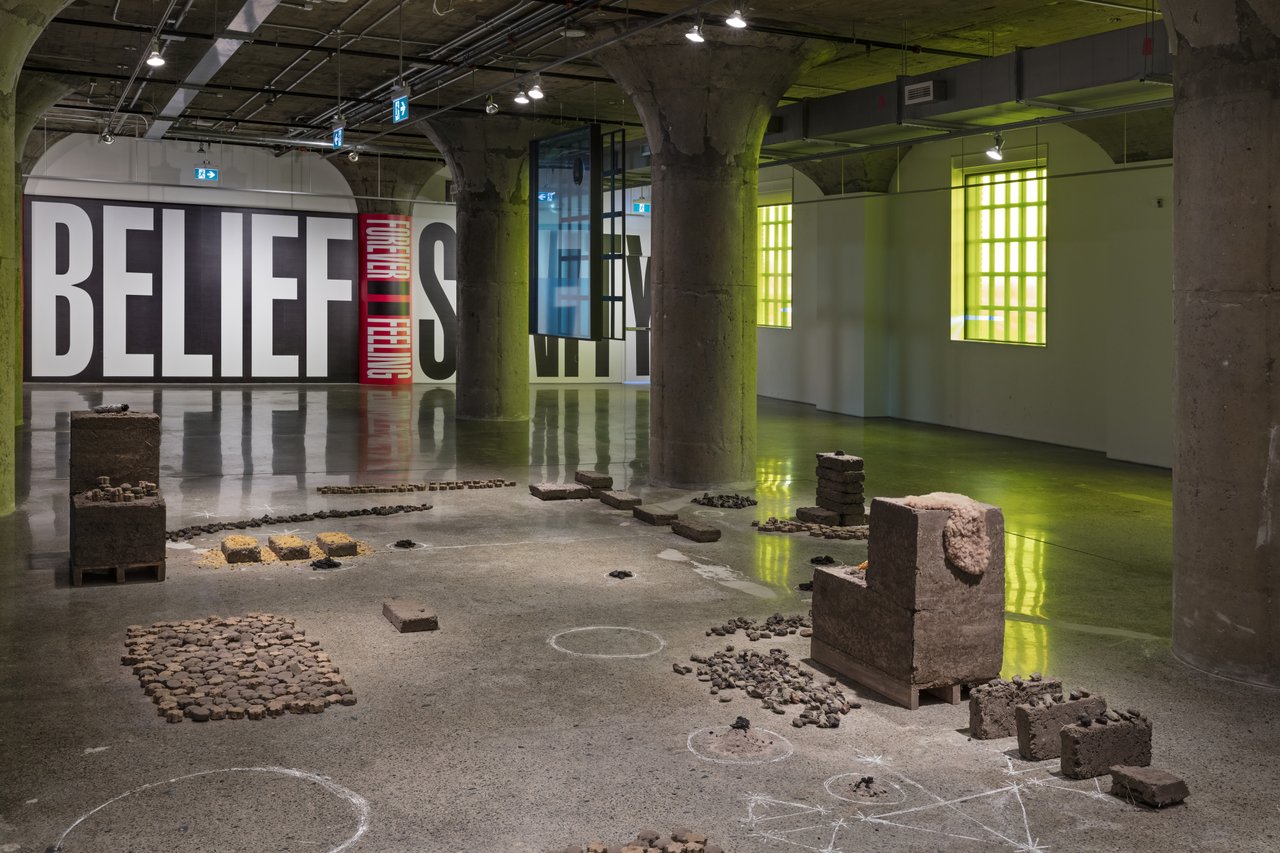
In its curatorial framework, Believe does this: it “considers beliefs and systems that are the foundation from which our civilization has been built: personal and collective beliefs that form the conditions, values, and identities that define existence in the globalized world of the 21st century.” Putting aside its robotically didactic tone, this text operates as a coverall gesture, but one marked by specific directives. Effectively, it points to what artists do and files this under “belief” (as in, “they believe in themselves, and in the power of art!”). It then celebrates itself – as a show, a museum – for offering these artists, and this conviction, a platform. Curating through PR-laced platitudes, MOCA risks flattening out and cheapening artistic insight and discovery. It also denies its audience the opportunity to arrive at the work from strange angles. Most troubling, though, is how this framework overrides something intrinsic to an artist’s searching and labor: doubt and the unknown. In place of this, and in place of encounter, we see artists tied to a kind of presumptive devotion. It’s a familiar narrative, though: it takes its cues from the mythological tropes of an artist’s wager with adversity, determination, and self-abnegation (we might as well get ourselves a whip!). If the artist is lucky, their story concludes with mystical inspiration and some narrowly-achieved reward. It’s nothing new, then, to halo the artist with a barely secular recasting of faith. However, to frame belief as a “choice,” rather than a determined set of influences, is risky in new and specific ways.
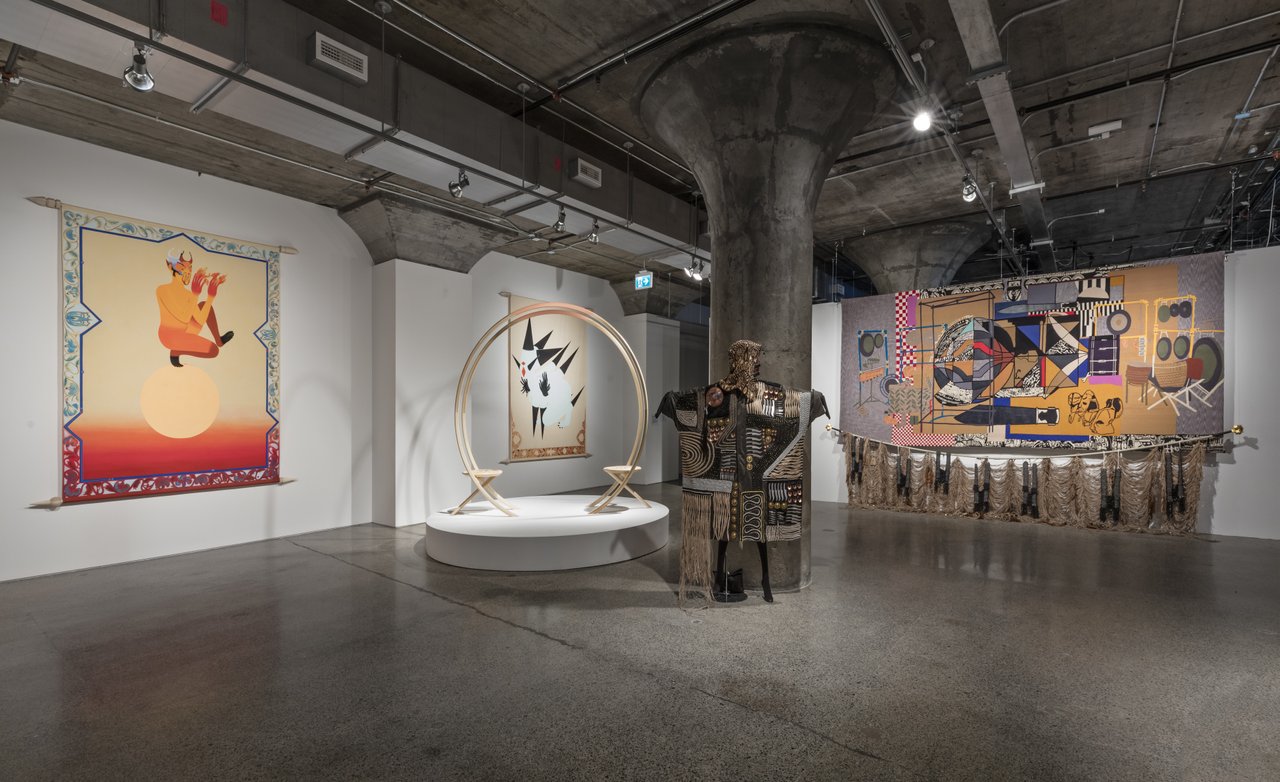
MOCA Toronto has been hailed for respecting its historic site – a 1919 automotive tower – and, indeed, its architects have prized the building’s bones. (“The structure is basically a found object, its concrete floors and concrete mushroom columns polished and sealed; new windows mimicking the old,” swooned the Globe and Mail.) However, Liss’s show largely resisted or denied the challenges and charms inherent to its idiosyncratic site. He worked against the difficulties of this raw and uncompromising space, inventing reasons to cut it up and shorten its vantage points. As though taking a cue from the biennial circuit (or, closer to home, the Power Plant’s fatiguing, video-reliant program), Believe cuts off important ground by clumsily cordoning off space for video and film. In such exacting real estate, these works are given extra pressure: positioned as if to teach us something, rather than envelop and affect. Operating like an exquisite-corpse, the exhibition loudly emphasizes its works’ lonely states: speaking often into a wall, or the elbow of another nearby piece, delimited only by tape.
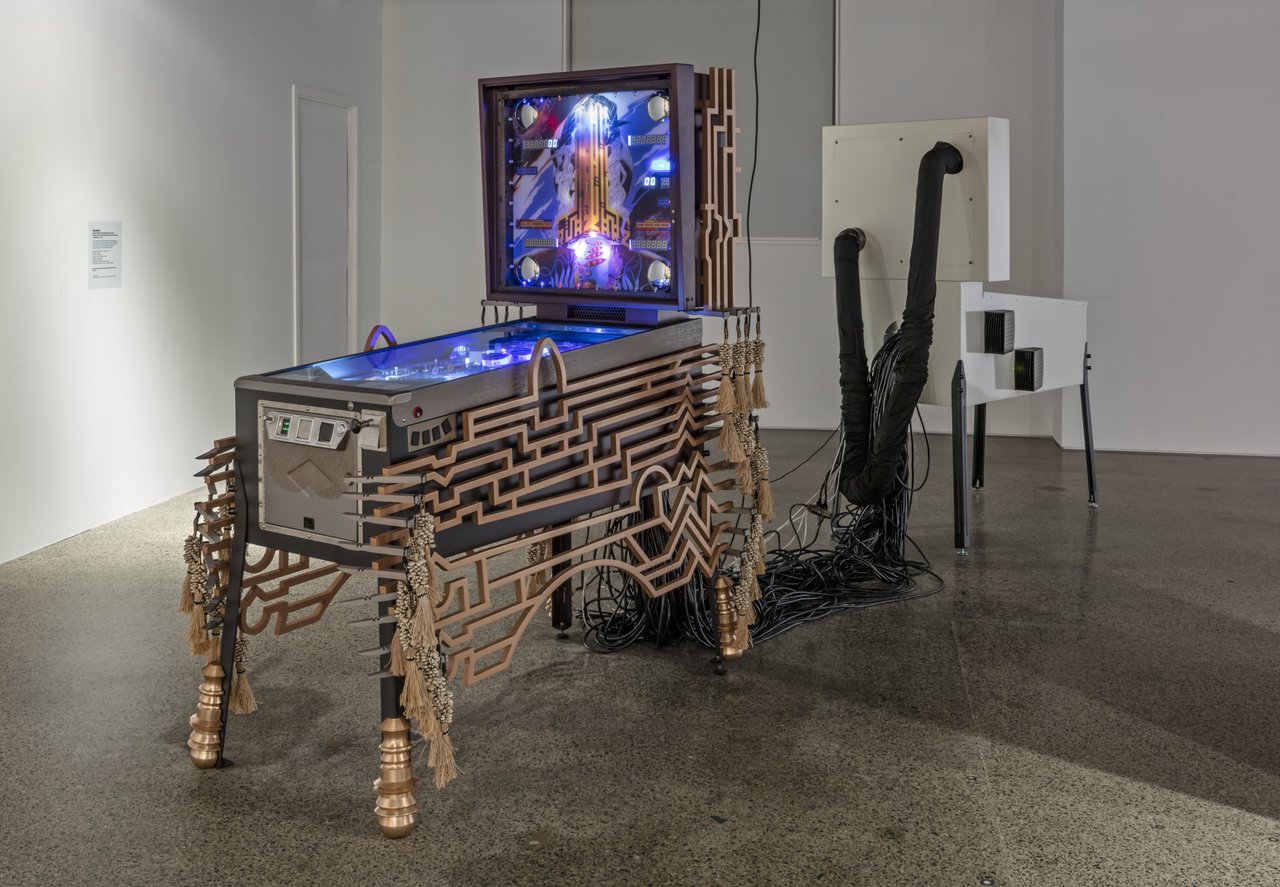
Liss has repeatedly stated that his curatorial approach is one of inciting a conversation – or in this case, “less like a conversation and more like a cocktail party, many voices chattering at once.” Indeed, voices compete. But like a party of unhearing people, Believe isolates its streaming voices, reducing them to fragments and overlaid arguments. Tim Whiten’s otherworldly sculptures, which imagine the locus of knowledge, appear adrift and bloodless. Nikolaj Bendix Skyum Larsen’s three-channel Promise Land (2011) reads – almost too appropriately, given his migrant subjects – as marooned and wanting. Awol Erizku, made famous for his portrait of a pregnant-with-twins Beyonce (MOCA’s media-portfolio is only too pleased to tell us this, along with the number of Instagram likes it garnered) is showcased through several sculptures that are turned in on themselves, or towards the wall, despite the fact that they’re meant to “demand space” and communicate across time. Their symbolism appears resigned to emitting transmissions, with no receiving signal. Jeremy Shaw’s Quickeners (2014) emits a looming, anxiety-inducing audio, and convincingly scripts a cultish transcendence. It’s one of the strongest pieces in the show, but shouldn’t have been allowed to dominate everything in its path. Meanwhile, Nep Sidhu, an ascendant artist, is centrally positioned with several works, among them a specially-engineered pinball machine. Amid a gallery stacked with keening and coded sculptures and paintings, each one clamoring for attention, Sidhu’s engineering is reduced to an interface where we simply lean in to see results. In this context, it might be too smart to go deep.
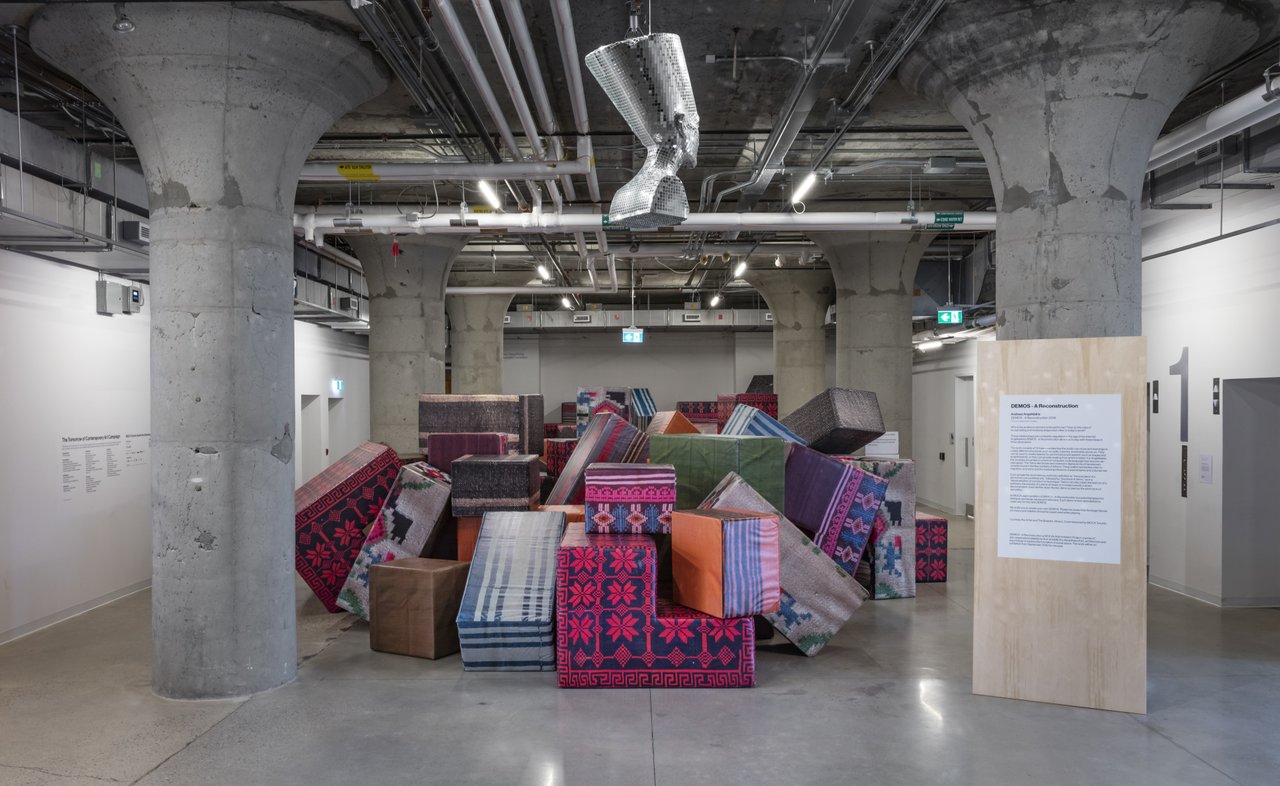
Many leading figures play tired tunes, here. Carl Beam’s well-worn The Columbus Suite (1989-92) initiates the exhibition, a prized piece from the MOCA collection, but too often exhibited. Similarly, Barbara Kruger is commissioned to do what she does, working the key word – Belief – into a marquee, and then, through her own celebrity, flattening it like a brand. And there’s Andreas Angelidakis’s “socially-minded” patterned modules. This is presented as a commissioned work, but nearly identical to Angelidakis’s ottomans at Documenta. (Really, I beg of you, Toronto: stop assuming we don’t travel to see art! We’re in the world.)
I can understand MOCA Toronto’s zooming out to include more international names than we were used to at MOCCA, and, in however dated a way, claiming this represents our “globalized” artworld. Toronto is diverse and deep, and we needn’t limit ourselves to familiar names. This show, though, is a stretch for Liss, and unconvincing in its configuration. He seems to be vaguely striking at hot-button political subjects – gentrification, the refugee crisis, cultism, Indigenous symbolism, colonialism, social engineering – and he does so with little regard for how these subjects might coalesce. What emerges is not a testament to belief so much as a reminder that each of us is schooled in some form of hard-won, niche knowledge. I suppose that each of us wields this with varying degrees of faith, or more likely doubt. But it’s knowledge, not belief, that informs our best convictions. That we should give short-shrift to artists’ knowledge, and ask, instead, for divination, shows a lack of faith in the length and depth of what they do.
Listen, I want to believe in MOCA! Of course I do. As an institution it stands to address an important gap in our community, and our country. However, when met with this kind of lazy, hazy curatorial conceit, I think of Ben Davis’s observation that “I truly believe in the cause of art, which means I believe in art as part of the cause of a better world. It is just that, if you aren’t very careful about how you mean it, protestations about the importance of art become platitudes – in fact, they become a way of setting it above other, less glamorous human concerns […].” I might add, too, that Believe calls up Susan Sontag’s writing on the risk of cherry-picking ideologies for art: “For the modern post-religious man the religious museum, like the world of the modern spectator of art, is without walls; he can pick and choose as he likes, and be committed to nothing except his own reverent spectatorship.” After a long time of thinking on this, I’d simply say: you’re MOCA Toronto. You aspired to a higher tier of institutional recognition, and you claimed it. Now assume we’re reaching for and claiming something, too.
