
There is a quality of lore around Jana Sterbak. Alongside her temperamental performances and pyrotechnic affinities, she is the artist of burning crowns, interred sweat, chocolate bones, and garments hosting chest hair and stitched from flank steak. Czech-born and Montreal-based, Sterbak deals in images and materials that invite this aura too—hers is a practice full of beckonings that become feints; she pulls in our witness before repelling it. Through an enduring engagement with the existential questions anchoring so much Czech literature and poetry, her provocative iconoclasms and push-pull dynamic work on the viewer’s body—and on what the body is willing to believe.
A few years after a ripple-inducing exhibition at Toronto’s Mercer Union in 1982, Sterbak began showing on both sides of the Atlantic. Rebuking her contemporaries’ taste for photo-based minimalism and their preoccupation with appropriation, and asserting what curator and writer Jessica Bradley calls “expressionist materiality,” Sterbak proposed a practice that positioned her as a restless descendant of artists like Meret Oppenheim, Louise Bourgeois, and Eva Hesse. Her brilliant and at times controversy-flaring arc culminated in a survey at the National Gallery of Canada in 1991, which featured her iconic “meat dress,” Vanitas: Flesh Dress for an Albino Anorectic (1987). Composed of sixty pounds of stitched flank steak, the piece inspired a media storm. (A year earlier, the New Museum in New York had considered including the dress in its Sterbak exhibition but balked, deeming it too combustible. “Canada is Canada,” a museum spokesperson told The New Yorker’s Adam Gopnik. “You do that here and who knows what will come out of the walls?”) A decade later, in 2003, Sterbak represented Canada at the 50th Venice Biennale.
In the twenty years since, however, you were more likely to encounter Sterbak’s work on a slide projector than in person—and for students of Canadian and contemporary art history, this added to her aura of “you had to be there.” Part of this drift owes to the natural swells and dips of a long career and to that particular post-Venice fallback an artist can brook. And part of it owes to the material sensitivity and technical specificity of Sterbak’s oeuvre, which for decades has largely sat undisturbed but protected in institutional collections. She recounted a story during her artist talk at the Esker Foundation in Calgary, of a major institution that did not really understand what it had, in collecting her work: what it thought was the work was just the encasing. Meanwhile, Sterbak’s technologies are increasingly fussy for a new generation of conservators and curators.
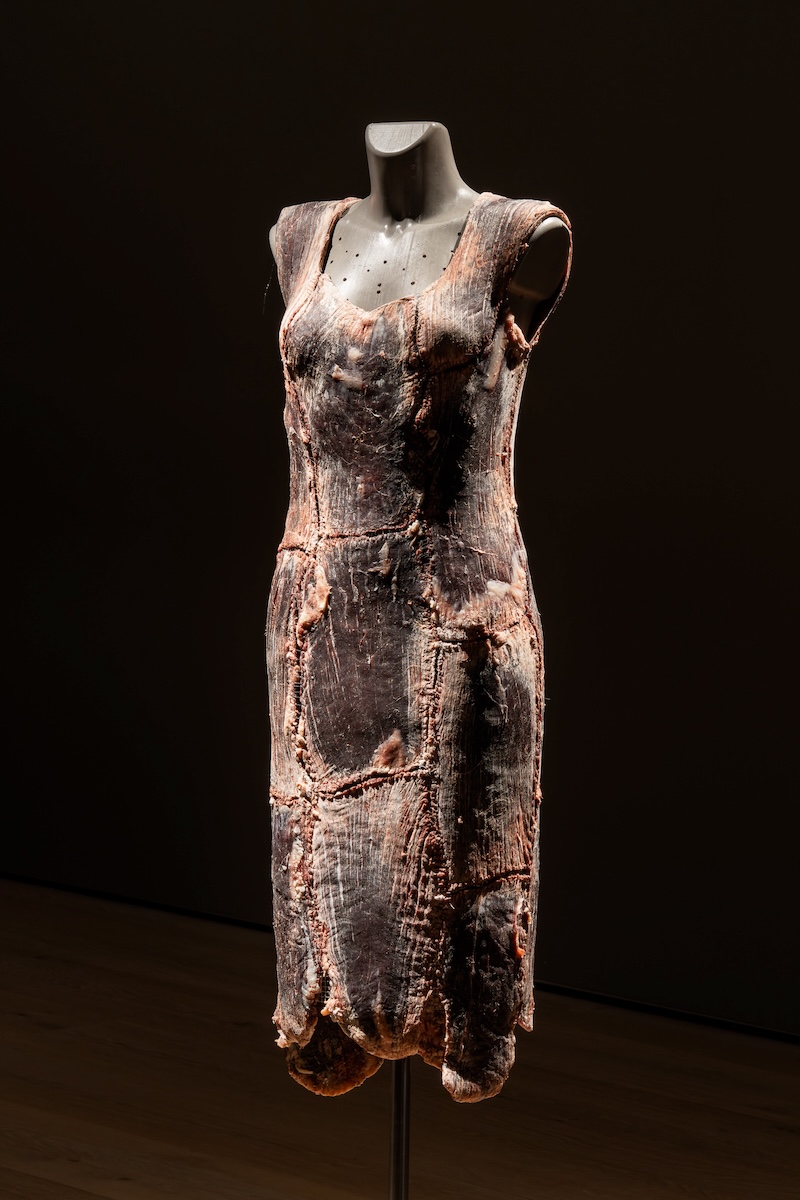
There was also a theoretical discourse that assembled itself around Sterbak’s work in the ’80s and ’90s, framing—or stalling—her themes within discussions of the body and women’s bodily autonomy. This discourse hasn’t maintained its coordinates (even if the stakes for women’s bodily autonomy have only grown), and when Lady Gaga wore the infamous dress at the 2010 MTV Video Music Awards without attribution, the artist’s signature on our culture could be seen as both indelible and faint.
Across these misrecognitions, appropriations, and slippages, the work reflects its own shimmering agenda—obscuring and revealing its meanings like a fan opening and closing on a creaking pivot. However, two recent exhibitions resurface and recharge the artist and grant her a widening. In Corpus Insolite, presented at the Musée des Hospitalières de l’Hôtel-Dieu de Montréal (January 26–August 24), art historian Johanne Sloan curated Sterbak through a resonant, lightly interventionist plumbing (or riff) of a charged site. In Dimensions of Intimacy, at the Esker Foundation (September 20–December 21), director and curator Naomi Potter rightly celebrated Sterbak’s enduring elegance and existentialism in a grand but concise retrospective. In both cases, viewers were treated to the artist’s most symbolizing pieces (several appeared in both installations) and given a sensual tour through work that rewards being in the room with it, to sense, smell, and react. For many of us, these opportunities offered a long-awaited chance to do just that: Meet Sterbak’s work in the flesh. But these two shows also clarified, in different ways, how Sterbak continues to elide attempts to define her practice, instead leaving viewers with corporeal encounters that carry the trace heat and energy of a recent combustion. Her art is radial rather than immediate, more afterimage than impact, and suggests a power at work that exceeds us. Less menace than mischief, Sterbak withholds mastery while quietly reorganizing desire, control, and belief.
***
The Musée des Hospitalières is an institution that, despite its central position in Montreal’s popular Plateau neighborhood and its large footprint near Mount Royal, many Montrealers had never heard of or entered before. Sterbak lives nearby and was apparently friendly with its stewardship, and her relationship triggered the exhibition and marks the Musée’s first-ever involvement with contemporary art. The institution is a complicated site: It has long been dedicated to telling the story of the French nuns whose mission was to heal but also colonize upon their arrival in the mid-seventeenth century. Their work in establishing several hospitals includes a legacy of converting Indigenous inhabitants to Catholicism and imposing strict limits on Montreal’s cultural evolution. Sterbak’s work is dotted throughout this tightly packed—and sometimes stifling—permanent collection.
The exhibition marks Sloan’s first project as a curator, but she has a long career of researching and writing about the artists of the 1950s and ’60s who helped set in motion Montreal’s rapid secularization. In her curatorial essay, she asks, “What does an institution like Hôtel Dieu signify today, more than half a century after the Quiet Revolution of the 1960s, when the vast majority of Québecers rejected the authority of the Church?” Sterbak’s work in this context seems to sidestep the question—though it isn’t really hers to answer—and in lieu of an institutional critique, the work treats its airless environment as a funneling for its flammability. This includes Hot Crown (1998), positioned in a kind of altar-like alcove. Heat-activated by encroaching visitors, the totemic sculpture feels uncannily attuned to its medical setting, carrying connotations of the electrical helmet developed by doctors at the Salpêtrière hospital in Paris to treat psychological disorders. While the crown has become a signature motif of Sterbak’s, calling up the flaming nimbi of apostolic iconography, its ignition here seems fateful and fitting. Hot Crown poses several provocations to the viewer: Is our power activated only by want? By witness? What power do we still retain—however unfused—when nobody’s looking? These prompts take on a different sheen within their colonial site, glinting with associations of state control, religious authority, and supplication.
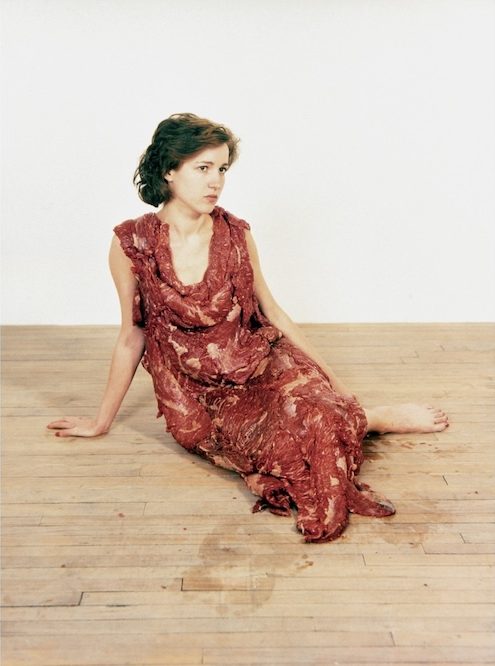
Visitors finished with the Vanitas meat dress, nicely curing by the time I visited in late August. The work, like the reliquaries nearby, carries an undeniable aura—if foremost for its celebrity. A photo of a model wearing the dress upon its first showing hangs in view. In the image, she forms a pensive shape in an odalisque pose on the floor, propping herself on one arm. Though the very embodiment of a rubescent provocation—of being inside out—there is something sublime about her: undisturbed, self-possessed, and slightly saintly.
***
In late September, spotlit in Calgary with the Esker Foundation’s well-talked-about resources (it’s one of the few institutions artists consistently rave about), Sterbak cuts a different profile. Compared to the Musée des Hospitalières exhibition, she has less to agitate against; instead, she is given a late-career show worthy of the work: elegant, cutthroat, and clear in its assertions. As I walked through the exhibition’s intimate stagings, I felt revelation being gently coaxed—through scale and light, mostly—yet each gesture ultimately reaffirmed Sterbak’s evasions and the irresolvable chimera animating her practice.
That coaxing was often spatial. Curator Potter was largely sensitive to the challenge of carving out intimate spaces within the Esker’s large galleries, as though creating portals through which the work could more intensely conduct its power. In many instances she produced these intimacies through lighting alone. Vanitas, for instance, fared better in this context than in Montreal. Under a couple of spotlights in an otherwise inky room, the steak hung like purple velvet, lean and shimmery in its tendon-ribboned sheen.
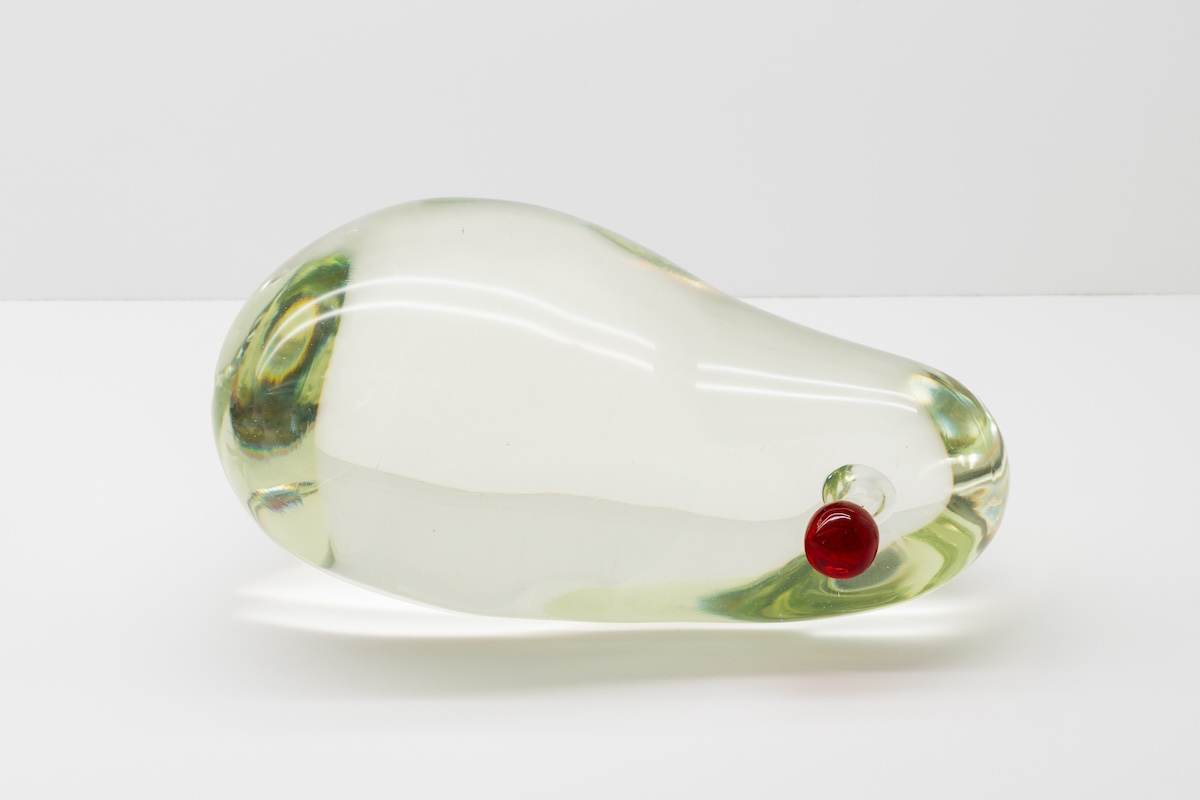
Sterbak’s famed chocolate skeleton, Catacombes (1992), was on view in both exhibitions but is more strongly presented at the Esker. Made in Paris where she could visit the catacombs (Sterbak’s deadpan comment on the bones: “They really did look like chocolate”), the bones were easy to miss in Montreal, squeezed among queasy contraptions and trappings such as archaic medical instruments and wax-modeled diseased body parts. In that context, I believed the bones were real. But at the Esker, the piece was placed in a low-slung niche at the level of your shoes, like a grave site or an archaeology showcase, in a way that’s both contemporary and a little bit funny. You had to get low to appreciate them, so their material revealed itself like something private whispered in your ear.
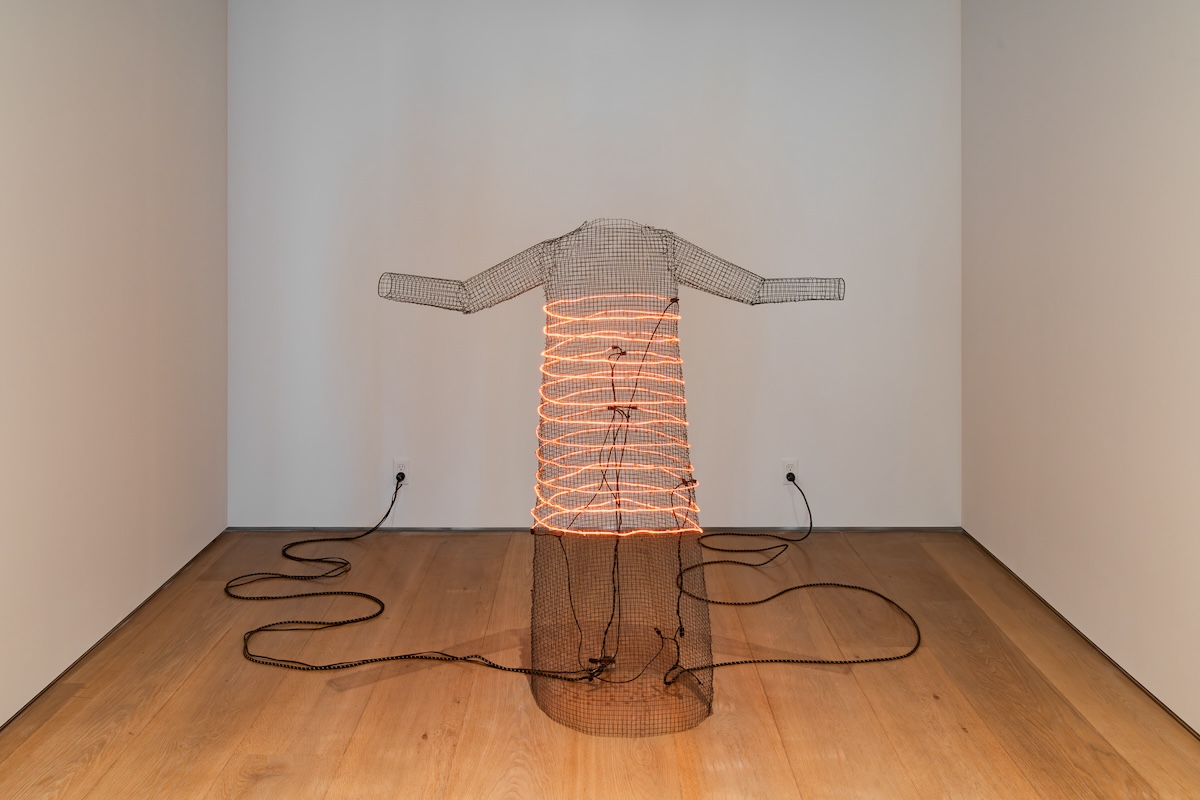
This clean survey did some heavy lifting, including a spare and blazing presentation of I Want You to Feel the Way I Do . . . (The Dress) (1984–85), a hollowed-out (rather than inside-out) dress wound with live heating wires that flare red-hot as viewers approach. [Describing a similar work, the literally hot Corona Laurea (noli me tangere) (1983–84), Diana Nemiroff—who curated Sterbak’s landmark 1991 exhibition at the National Gallery of Canada—termed it “a diabolical machine.”] Then there was Seduction Couch (1986–87), made of perforated steel and a floodlamp that exemplifies the perils of intimacy: the bed crackles with light when you approach it, an object made more dangerous by its affiliations with analysis and sex. These two works resist easy capture; the threat of flammability and shock appears only when viewers get close, forcing us to retreat.
Sterbak’s overarching themes of dependency and self-determination, and her playful pickup of Surrealist motifs, including the contradictory impulses of desire and the merging of machine and animal, are synthesized in Remote Control II (1989), a battery-powered aluminum crinoline hoop skirt set on motorized wheels. The sculptural artifact was accompanied by video footage of its activation at the National Gallery of Canada in 1991, where its wearer was suspended and variously controlled by audience members. Viewing the static skirt’s hard edges and slightly homemade pelvic basket now, especially against the backdrop of its recorded performance in black and white, is to appreciate the cryptic and impish hurdles Sterbak set for herself, her performers, and her audience.
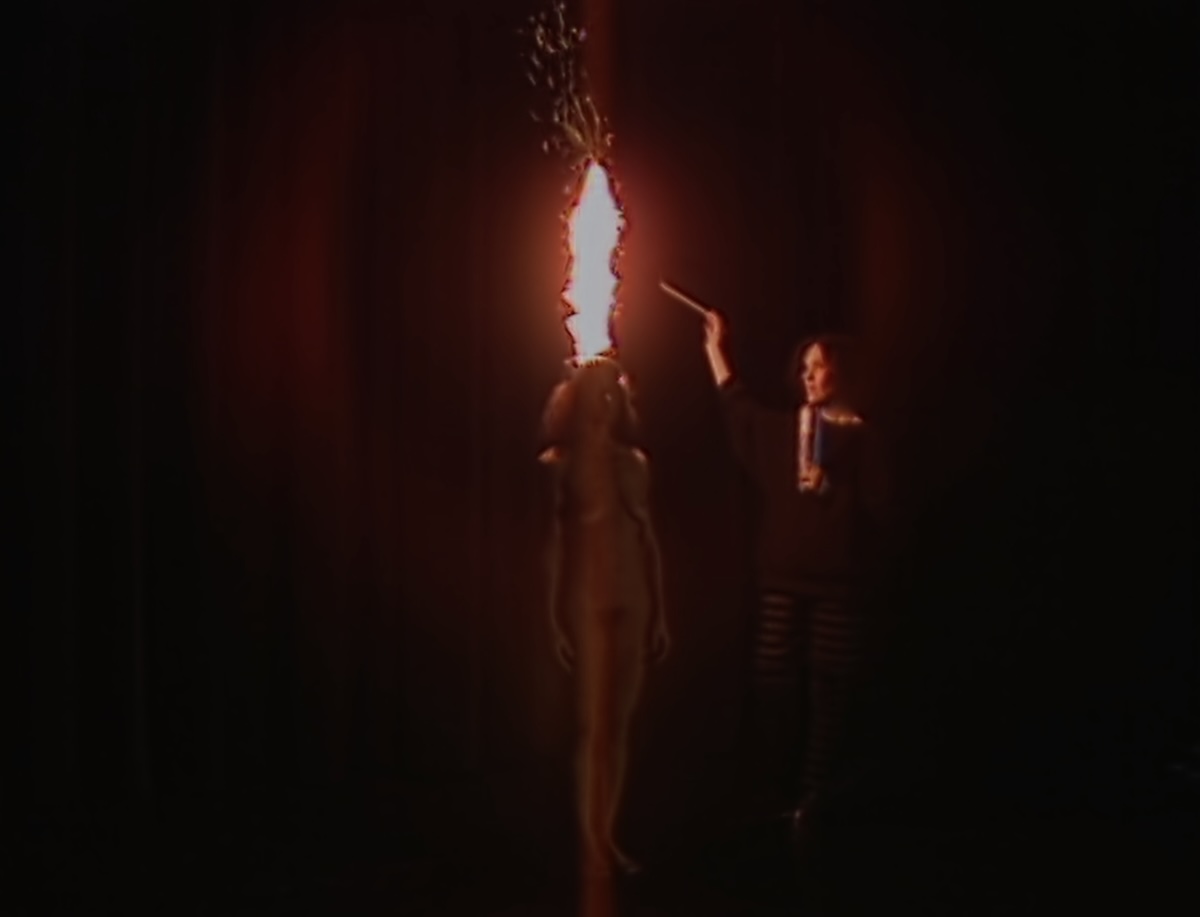
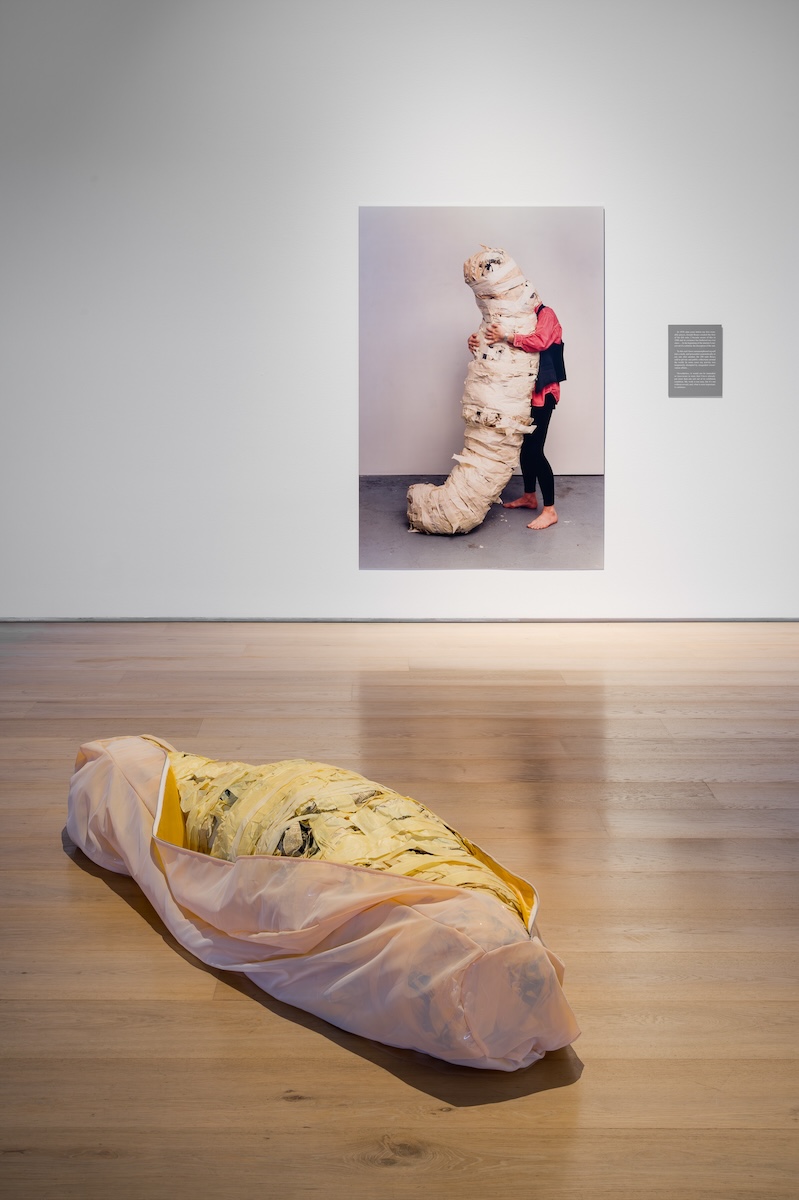
The feeling was only accentuated by the pieces in its orbit, including Absorption (a work in progress) (1995), a body-size canvas bag lying prone on the floor, unzipped to reveal a figure wrapped in paper. The work represents the entrails of Sterbak’s effort to metamorphose into a moth in order to devour each of the one hundred editions of Joseph Beuys’s iconic felt suits. It’s reinforcing a strength in her sculptural practice of setting the performance—or the imagined act—ablaze in the viewer’s mind. In Artist as Combustible (1987), a nearby video featuring a naked young woman being lit like a human candle (the artist herself makes the ignition), the flame in her hair flares and dies quickly, on a loop, leaving us trying to catch its lingering nimbus, its ambient glow.
These works are more quixotic than baleful and return us to Sterbak’s sharp deployment of humor—a quality renewed by these two recent exhibitions. Her descriptions of power are underlined by wit and timing, like a prank, a pulled card, a rabbit briefly transfigured before disappearing again. But encountered in the flesh, this humor is inseparable from sensation: heat that flares and recedes, materials that sweat, cure, glow, or withhold themselves just long enough to frustrate our grasp.
Sterbak’s central concern seems to be, how can we move? What holds us back? What becomes possible, given where we’re coming from and where we are? She addresses these questions almost ruefully—not by offering answers but by staging conditions. As the remote-controlled skirt, the burning crowns, and the obscured figure cocooned in its body bag remind us, agency here is never abstract: One negotiates it through proximity, desire, hesitation, and touch. Further, Sterbak shifts the question of control onto the viewer’s body. What we’re left with is not mastery but residue: What we remember seeing, smelling, hearing—and what we’re still unsure we witnessed at all. Power lingers not as a spectacle but as an aftereffect, held in the senses and limited by what we understand to be true.